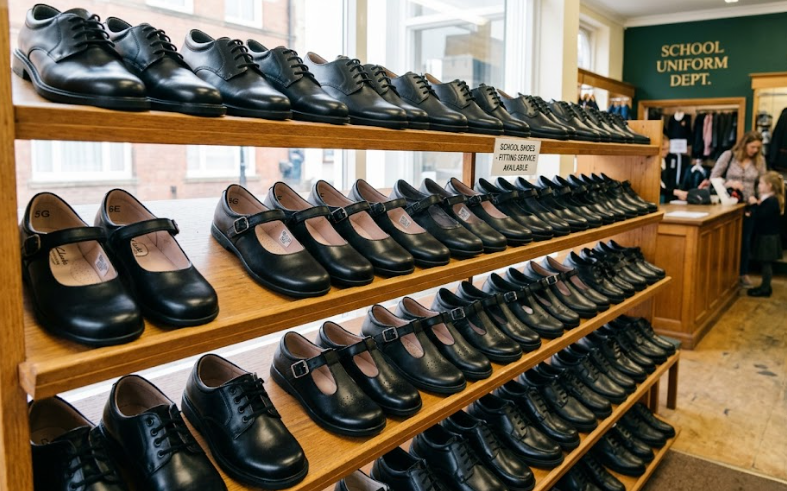
The back-to-school season in the UK is more than a calendar date — it is a significant annual event for families, retailers, and the children who will spend five days a week in their school shoes. The UK children’s footwear market was valued at approximately $2,796 million in 2025, with the school shoes segment holding the leading position among all product types. As the 2026 academic year approaches, parents across the country face the familiar challenge: finding school shoes that fit properly, last the year, and meet uniform policies without breaking the budget.
This guide offers everything you need to know about buying school shoes for the 2026 school year, from understanding when to shop to choosing the right style, getting a proper fit, and making your purchase last.

📅 When to Buy: Timing Your Purchase
One of the most common questions parents ask is when to buy school shoes. The sweet spot for most families falls in July or August. Here is why timing matters:
Children’s feet typically grow by half a size every 2–3 months during the primary school years. Buying more than six weeks before term starts risks the shoes being too small by September. However, leaving it until the last two weeks of August means competing with every other family in your area for fitting appointments.
⏰ Timing Tips for 2026:
• Best time: First two weeks of August 2026
• Peak season: August–September (Back to School)
• Exception: Reception starters — book a fitting in May/June and re-check in late August
• Replace frequency: 2–3 times per year for growing children
The back-to-school season (August–September) and the autumn/winter weather transition together account for over 40% of annual revenue in the UK children’s footwear market. This concentration means that popular sizes and styles sell out quickly, so planning ahead is essential.
👣 Why Proper Fitting Matters
Children’s feet are not just small versions of adult feet. Bones are still forming, tendons are flexible, and the arch develops throughout childhood. A poorly fitted shoe worn for six hours a day, five days a week can cause long-term foot problems.
According to Start-Rite, the key signs of a well-fitted shoe are:
- ✅ Thumb’s width of space at the front of the shoe
- ✅ Width fitting — the shoe should not pinch at the sides
- ✅ Heel grip — the heel should not slip when walking
- ✅ Flex point — the shoe should bend where the foot bends

🏆 Top UK School Shoe Brands for 2026
Here are the most trusted school shoe brands in the UK, with starting prices and key features:
🧵 Leather vs Synthetic — What’s Best?
One of the biggest decisions parents face is whether to buy leather or synthetic school shoes.
Leather school shoes are the traditional choice in the UK. They are breathable, mould to the foot, and last longer if properly maintained. However, they tend to cost more and require regular polishing.
Synthetic shoes are cheaper and easier to clean with a wipe. On the other hand, they do not breathe as well, which can lead to sweaty feet, and they do not mould to the foot.
For children who wear school shoes every day, leather is generally the better investment. Many schools now specify leather shoes in their uniform policies due to the durability and professional appearance.
🛠️ How to Make School Shoes Last Longer
School shoes take a beating. Here is how to extend their life:
- 🔹 Polish regularly — leather needs conditioning to prevent cracking
- 🔹 Use shoe trees — helps maintain shape and absorb moisture
- 🔹 Alternate pairs — if possible, rotate two pairs to allow drying
- 🔹 Check fit monthly — feet grow fast, catch it before shoes get too tight
- 🔹 Clean daily — remove dirt and mud to prevent damage
📚 Resources & Related Sites
Explore these trusted platforms for more information on school shoes and children’s foot health:
These organizations offer expert fitting advice, quality footwear, and resources for parents.
📈 Back to School 2026 Trends
For the 2026 school year, the trend is shifting towards lightweight, flexible soles that support active children while maintaining the smart appearance required by most UK schools. Retailers are also reporting increased demand for wide-fit shoes and extra-depth styles as parents become more aware of the importance of proper foot development.
The UK children’s footwear market is projected to grow at a CAGR of 6.17% from 2026 to 2034, reaching an estimated $4,785 million. This growth is driven by rising awareness of foot health and the steady stream of back-to-school shoppers.
❓ Frequently Asked Questions
✅ Final Thoughts
🌟 “Good school shoes are an investment in your child’s health and confidence.”
Buying school shoes for the 2026 academic year does not have to be stressful. By timing your purchase right, choosing a reputable UK brand, ensuring a proper fit, and maintaining the shoes properly, you can set your child up for a comfortable and successful school year.
Whether you choose leather or synthetic, visit a store for a fitting or buy online, the key is to prioritise comfort and foot health. After all, children spend an average of 6 hours a day in their school shoes — they deserve the best fit possible.
- 📅 Shop in August for the best selection
- 👣 Get feet measured professionally
- 🧵 Choose leather for durability
- 🛠️ Polish and maintain regularly
Prepare for the 2026 school year with confidence — one step at a time.