Most schools do not have an intervention problem. They have an intervention logistics problem. The pupils are identified, the staff are willing, the programmes are chosen, and then the plan collapses somewhere between Tuesday’s timetable and Thursday’s room clash.
If that sounds familiar, the fix is rarely working harder. It is updating how you schedule. Below are seven practical shifts that schools of every size can make this year, whether they use a dedicated RTI scheduler, a spreadsheet or a mix of both.
1. Move From Term-Long Groups to Short Cycles
The old habit was simple: build groups in September, run them until Christmas, and hope for the best. The trouble is that pupil need changes faster than a term.
A better rhythm is the short cycle: three to six weeks of targeted work, followed by a quick review, followed by a fresh regroup. Pupils who have made progress move on. Pupils who haven’t get a different approach rather than more of the same.
Short cycles only work if regrouping is cheap. If rebuilding your groups takes an afternoon, you will avoid doing it. If it takes ten minutes, you will do it every cycle. That is the real argument for scheduling software: it makes frequent, responsive grouping realistic.
2. Track Minutes Delivered, Not Sessions Planned
A timetable shows what you intended to happen. It does not show what actually happened.
Try keeping a simple minutes ledger for each pupil receiving support: planned minutes, delivered minutes, and the gap between them. Gaps appear for ordinary reasons, such as absences, trips, cover lessons and exams, and they add up quietly.
When you review impact at the end of a cycle, this ledger changes the conversation. Instead of asking “Did the intervention work?” you can ask “Did the pupil actually receive enough of it?” Those are very different questions, and the second one has to be answered first.
3. Write Exit Criteria Before You Start
Every intervention group should have a way out. Before a cycle begins, agree what success looks like: a benchmark score, a reading age movement, an attendance target or a behaviour measure.
This does three useful things:
- It stops pupils drifting in support groups indefinitely.
- It frees up limited staff time for pupils who need it more.
- It gives pupils and parents a clear, motivating goal.
Your scheduling process should make exit visible. When a pupil hits their target, the system (or your spreadsheet) should prompt a review, not wait for someone to remember.
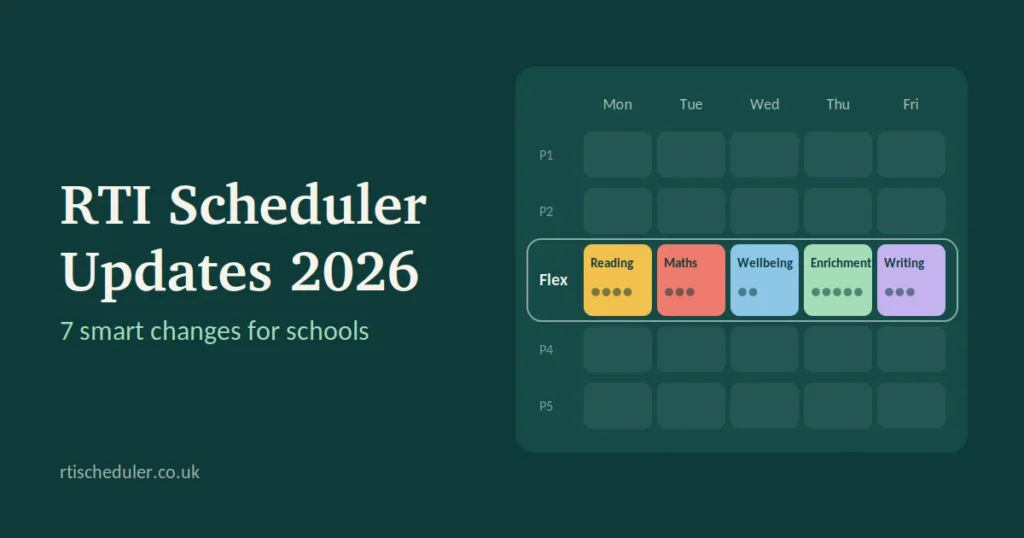
4. Audit Your Flex Time Once a Term
Protected intervention or flex time is one of the best structural decisions a school can make. It is also easy to let it erode. A slot gets borrowed for an assembly, a catch-up test or a trip, and slowly the protected time becomes unprotected.
Once a term, run a five-question audit:
- How many planned flex sessions actually ran?
- How many were shortened or cancelled, and why?
- Were any pupils pulled from core lessons because flex time wasn’t available?
- Are room and staff allocations still sensible?
- Is the block still in the right place in the week?
If you can’t answer these quickly, your data is not in one place. That is the first thing to fix.
5. Give Pupils Controlled Choice
Not every session needs to be assigned. For enrichment, study support and some catch-up work, letting pupils choose from open sessions increases ownership and attendance.
The key word is controlled. Pupils who need specific intervention should be placed in it by staff. Pupils who don’t can choose from sessions with limited seats. This mixed model gives you both accountability and engagement, and it makes the flex period feel like an opportunity rather than a punishment.
6. Plan Academic and Pastoral Support Together
Many schools schedule literacy and numeracy interventions in one place and wellbeing, behaviour or SEMH support in another. The pupil, of course, is the same person.
When these plans sit in separate systems, clashes are almost guaranteed. A pupil might be booked for a reading group and a mentoring session in the same slot, or removed from too many lessons in a single week without anyone noticing.
Combining all targeted provision into a single view lets you see a pupil’s whole week. It helps you spot overload, protect learning time, and give pastoral and academic teams a shared picture instead of competing lists.
7. Treat Data Handling as Part of the Schedule
Intervention lists contain sensitive information: attainment gaps, behaviour concerns, additional needs. Whatever tool you use, data handling belongs in the scheduling conversation.
A few habits go a long way:
- Limit who can see which groups, based on role.
- Avoid sharing full pupil lists in unsecured emails or messaging apps.
- Know where your scheduling data is stored and who processes it.
- Keep a record of what you hold and why, in line with UK GDPR.
- Make sure you can export or delete data cleanly when a pupil leaves or a contract ends.
Good scheduling isn’t just efficient. It is also careful.
Is Your Scheduling Process Keeping Up? A Quick Self-Check
Score one point for each “yes.”
- We can regroup pupils in under an hour.
- Double bookings are flagged before they happen.
- Every teacher can see their own roster without asking anyone.
- We know how many intervention minutes each supported pupil received last cycle.
- Every group has an exit criterion.
- Staff trust the schedule.
5–6 points: Your system is working well. Keep refining.
3–4 points: You are close. One or two upgrades, likely to grouping speed or tracking, would make a big difference.
0–2 points: Manual scheduling is costing you time and confidence. It is worth exploring dedicated software.
A 30-Day Plan to Put These Updates Into Practice
Week 1: Baseline. Record how long regrouping currently takes, how many sessions ran as planned last month, and how many clashes staff reported.
Week 2: Rules. Write down your entry and exit criteria, group size limits, session lengths and priorities. Agree them with the staff who deliver interventions.
Week 3: Pilot. Choose one year group. Build a short cycle, start the minutes ledger, and gather feedback from the adults involved.
Week 4: Review and expand. Compare against your week one baseline. Fix what didn’t work, then roll out to more year groups.
Where a Dedicated RTI Scheduler Fits
You can implement all seven updates with paper and spreadsheets for a while. But the more frequently you regroup, the more constraints you juggle, and the more evidence you need, the faster manual methods break down.
A purpose-built scheduler handles the repetitive parts: applying your rules, spotting conflicts, matching staff and rooms, and keeping a running record. That leaves your team free to focus on the part that matters, which is teaching and supporting pupils.
If you want to see how this works in practice, you can explore RTI Scheduler (UK) and try it on your own data before making any decision.
Frequently Asked Questions
What is an RTI scheduler?
It is software that plans and manages intervention sessions, matching pupils to groups, staff and rooms while avoiding clashes and tracking support over time.
How often should intervention groups be reviewed?
Every three to six weeks is a sensible rhythm for most schools, with quick checks in between for any pupil whose situation changes.
Do we need a protected flex period?
It isn’t essential, but it makes scheduling much simpler, because staff and pupils are free at the same time and core lessons are protected.
Can one system cover both academic and pastoral support?
Yes, and it is often better to plan them together so you can see a pupil’s full week and avoid overload.
How long does it take to change our process?
A focused pilot can be running within a month. Expect a further term to embed the habits.
Final Thoughts
The schools that get the most from intervention are not necessarily the ones with the biggest budgets. They are the ones with the most reliable routines: short cycles, clear exit points, honest tracking and schedules that people trust.
Start with one update from this list. Measure the difference. Then add the next. Small changes to scheduling add up to big changes for the pupils who need help most.