By jonsan
Published: September 5, 2026
Ask many adults about their teenage years, and something interesting can happen. Their voice changes. Their memories become more detailed. A person who struggles to remember what they had for breakfast may still describe the classroom where they sat at 15.
There is a scientific reason some of these memories can remain so vivid.
Psychologists use the term “reminiscence bump” to describe the tendency for older adults to recall a relatively large number of autobiographical memories from their teens and early adult years. A systematic review of 68 quantitative studies found that the exact age range varies depending on how memories are measured, but the effect commonly appears somewhere around ages 10 to 30.
That does not mean every high school memory lasts forever. Instead, research suggests that adolescence and early adulthood can become an especially important period for memories connected to identity, relationships, major life changes, and new experiences.
The Brain Was Still Developing
Adolescence is a major period of development. During these years, young people experience changes in how they think, manage emotions, understand social situations, and see themselves.
Those changes happen alongside a growing number of important life experiences.
A first serious friendship can feel completely new. So can a first relationship, a major achievement, a painful embarrassment, or an important decision about the future. Because many of these experiences are unfamiliar, they can receive a great deal of attention.
Researchers studying autobiographical memory have proposed that this combination of novelty, identity development, and emotional importance may help explain why memories from adolescence and early adulthood are often recalled later in life. The evidence does not point to one single explanation, however. Researchers continue to debate exactly why the reminiscence bump occurs.
That distinction matters. The reminiscence bump is a well-established pattern in autobiographical memory research, but scientists do not regard it as proof that every event from adolescence is stored more strongly than every event from other periods.
Identity Makes These Years Different
High school is also a period when many people begin thinking seriously about identity.
Questions that once seemed simple can become much more complicated. Who am I? Where do I fit in? Which friendships matter? What do I want from life? How do other people see me?
Some theories of the reminiscence bump connect the effect to these identity-forming experiences. Memories related to developing a sense of self may become especially important because they help people build a personal story about who they are and how they became that person.
This may help explain why an old photograph can sometimes feel more powerful than expected.
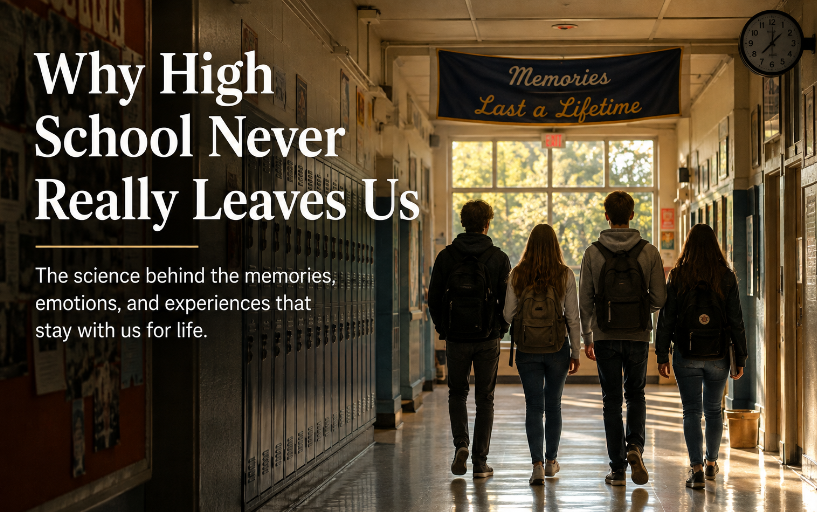
A picture from a school hallway is not simply a picture of a building. It may represent friendships, ambitions, worries, family expectations, or a version of yourself that no longer exists.
In that sense, remembering high school can sometimes mean remembering an earlier stage of identity.
Why Social Rejection Can Stay With Us
Not every powerful school memory is positive.
Being left out of a group, embarrassed in front of classmates, or rejected by friends can be deeply upsetting during adolescence. Research has found that peer relationships become especially important during these years, while sensitivity to social acceptance and rejection can also be heightened.
Brain-imaging studies have also explored how adolescents respond to social exclusion. One study found that teenagers with a history of chronic peer rejection showed stronger activity in brain regions associated with detecting and responding to social exclusion.
That does not mean every embarrassing school experience becomes a lifelong emotional wound.
Instead, the research suggests that social experiences can carry particular importance during adolescence. At an age when friendships and peer acceptance are becoming increasingly important, rejection can feel especially significant.
Years later, a similar situation may unexpectedly bring the memory back.
Nostalgia Has More Than One Side
Of course, high school memories are not all painful.
For many people, some of their happiest memories also come from this period. A favorite teacher, a close friendship, a school trip, a sporting achievement, a graduation ceremony, or an ordinary afternoon with friends can become deeply meaningful over time.
Nostalgia often works this way. A seemingly ordinary detail can become valuable because of what it represents.
A particular song may remind someone of a group of friends. A familiar smell may bring back a classroom. An old school uniform may recall a completely different stage of life.
Research on autobiographical memory suggests that the reminiscence bump is not limited to one type of experience. Memories can involve important personal events, public events, and broader life-script experiences. The precise age range also changes depending on the method researchers use to trigger memories.
So nostalgia should not be viewed simply as a longing for the past. It can also be a way of connecting past experiences with a person’s current sense of self.
Why Old Memories Can Feel So Close
One reason old memories can feel surprisingly immediate is that memory is strongly connected to cues.
A photograph, song, smell, location, name, or conversation can act as a reminder. Once that cue appears, other details associated with it may become easier to recall.
This is especially interesting in the context of the reminiscence bump. Researchers have found that the apparent age range of the bump can change depending on how people are asked to retrieve their memories. That suggests that the way memories are prompted plays an important role in what people remember.
In everyday life, this means an old memory may not have disappeared at all.
It may simply have been difficult to access until the right reminder appeared.
Moving Forward Does Not Mean Forgetting
Remembering high school does not mean someone is trapped in the past.
People continue to change long after graduation. New relationships, careers, responsibilities, achievements, and challenges create new memories and reshape how earlier experiences are understood.
In fact, the same memory can feel different at different stages of life.
A school failure that once seemed devastating may eventually become a useful lesson. An old friendship may be remembered with affection even if the relationship ended years ago. An embarrassing moment may eventually become a story that makes people laugh.
Time does not always erase memories. Sometimes it changes their meaning.
Why High School Can Stay With Us
The lasting power of high school memories is not simply about classrooms, exams, or teenage drama.
These years often combine several powerful ingredients: new experiences, changing relationships, emotional events, and the development of personal identity.
Research on autobiographical memory supports the idea that adolescence and early adulthood are unusually important periods for later recall, although the exact reasons remain an active area of study.
That may be why a person can leave school decades ago and still remember the sound of the bell, the layout of a classroom, or the face of someone they have not seen in years.
High school eventually becomes a chapter in someone’s life.
But for many people, it remains a chapter they can still open.
Research References
- Munawar, K., Kuhn, S. K., & Haque, S. “Understanding the reminiscence bump: A systematic review.” PLOS ONE, 2018.
- Berntsen, D. & colleagues. Research reviewing the role of cues in autobiographical memory and the reminiscence bump.
- Masten, C. L. and colleagues. Research on neural responses to social exclusion during adolescence.