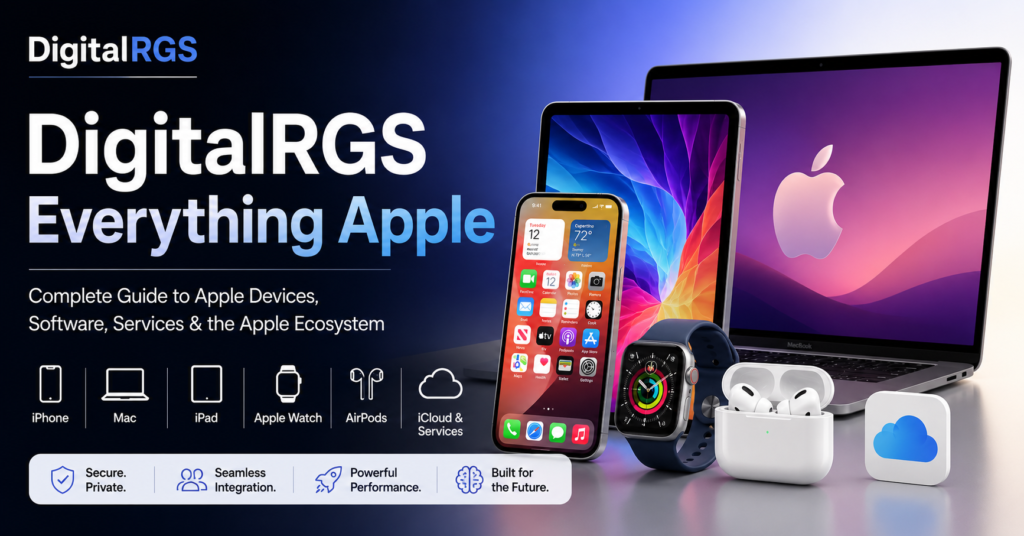
Technology has changed the way people communicate, work, study, create content, and manage everyday activities. Among the companies that have played a major role in this transformation, Apple stands out for building an ecosystem where hardware, software, and online services are designed to work together.
The phrase DigitalRGS Everything Apple represents a broad look at this ecosystem. Instead of concentrating on only one product, it covers the wider Apple experience, including iPhone, Mac, iPad, Apple Watch, AirPods, operating systems, cloud services, privacy features, productivity tools, and emerging technologies.
For someone who is new to Apple products, understanding how these components connect can make it easier to choose the right device and use it more effectively. Even experienced Apple users can discover features that simplify their daily routines.
What Makes Apple’s Technology Different?
Apple’s approach is based heavily on integration. Rather than designing every product as an independent device, the company creates a connected environment in which different products can share information and work together.
For example, a person can begin a task on an iPhone and continue it on a Mac. Photos captured with a phone can become available across other compatible devices, while files can be transferred between nearby products without relying on complicated cables or third-party services.
This approach can be particularly useful for people who own multiple Apple products.
The experience also extends beyond hardware. Apple’s operating systems and online services are designed to provide a consistent interface and account-based experience across supported devices.
iPhone: A Gateway to the Apple Ecosystem
For millions of users, the iPhone is the main entry point into Apple’s technology ecosystem.
A modern iPhone is much more than a communication device. It can function as a camera, navigation tool, entertainment system, payment device, productivity assistant, gaming platform, and personal information hub.
Different iPhone models are aimed at different audiences. Some users prioritize affordability and everyday reliability, while others need advanced cameras, larger displays, powerful processors, or additional storage.
When choosing an iPhone, buyers should consider how they actually use their phones rather than selecting a model simply because it has the highest specifications.
Photography enthusiasts may value camera capabilities, while professionals might prioritize performance and storage. Students may focus more on battery life, portability, and affordability.
Mac Computers for Work and Creativity
The Mac remains one of Apple’s most important products for people who need a full computer.
MacBook models provide portability, while desktop options are designed for users who prefer a permanent workstation. Depending on the configuration, a Mac can handle ordinary office tasks as well as demanding professional workloads.
Students can use Macs for research, writing, presentations, programming, and online learning. Professionals may rely on them for software development, graphic design, photography, video editing, music production, and business operations.
One of the major changes in recent years has been Apple’s transition toward its own silicon. These processors have allowed Apple to focus heavily on performance and energy efficiency within its computer lineup.
The result is a Mac experience that combines traditional desktop functionality with the same ecosystem philosophy found across Apple’s mobile devices.
iPad for Learning, Creativity, and Everyday Use
The iPad occupies a middle ground between a smartphone and a traditional computer.
Its larger display makes it useful for reading, studying, watching videos, drawing, browsing the web, and completing various productivity tasks. With compatible accessories, some iPad models can also become powerful tools for creative professionals.
Students can use an iPad for handwritten notes, digital textbooks, presentations, research, and educational applications.
Artists can take advantage of a compatible stylus for illustration and design, while business users may use the tablet for meetings, documents, email, and presentations.
The right iPad depends on the user’s requirements. Someone looking for a basic entertainment tablet does not necessarily need the same performance as a professional creator.
Apple Watch and Connected Convenience
The Apple Watch extends many smartphone functions to the wrist.
Users can receive notifications, check messages, monitor workouts, view important information, and interact with selected applications without constantly reaching for their phone.
Health and fitness are also major parts of the Apple Watch experience. Depending on the model and region, users can access different workout, activity, safety, and wellness-related features.
Its value becomes particularly noticeable for people who already use an iPhone because the watch is designed to work closely with Apple’s mobile platform.
Instead of replacing the smartphone completely, it acts as a convenient companion that provides quick access to useful information.
AirPods and the Wireless Audio Experience
Wireless audio has become another important part of modern technology, and AirPods are closely connected to Apple’s ecosystem.
They can be used for music, podcasts, video calls, online meetings, movies, and general communication.
One of the biggest advantages is convenience. Users who regularly move between compatible Apple devices can benefit from features designed to simplify connection and device switching.
Different AirPods models offer different combinations of sound quality, noise control, battery performance, and design. Therefore, buyers should compare their requirements before making a purchase.
iCloud and Digital Information
Cloud technology plays an important role in keeping Apple devices connected.
iCloud can synchronize supported information across devices, including photographs, documents, contacts, calendars, notes, and other data. This means users can often access the same information from different Apple products without manually transferring everything.
For families, students, professionals, and people who use several devices, this synchronization can save considerable time.
However, users should understand the difference between synchronization and backup. Having information available through the cloud does not mean every piece of data is automatically protected in exactly the same way.
Maintaining appropriate backups and checking account settings is an important part of responsible device management.
Apple’s Software Ecosystem
Hardware alone does not explain Apple’s popularity. Software is equally important.
Apple develops several operating systems, including iOS for iPhone, iPadOS for iPad, macOS for Mac, watchOS for Apple Watch, tvOS for Apple TV, and visionOS for Apple Vision Pro.
Each platform is optimized for its specific type of device, but they share common design principles.
Software updates can introduce new features, security improvements, performance changes, and compatibility enhancements. Keeping devices updated is therefore important for both functionality and security.
Apple also develops cross-device features that can reduce friction when users move between products.
AirDrop, Handoff, and Continuity
Some of Apple’s most useful features are not individual applications but tools that connect devices.
AirDrop allows compatible users to transfer supported files between nearby Apple devices.
Handoff can allow users to continue certain activities on another compatible device.
Continuity features can connect different parts of the Apple experience, making it easier to move from a mobile device to a computer or vice versa.
These tools are particularly valuable for people who frequently switch between an iPhone, iPad, and Mac throughout the day.
Instead of repeatedly emailing files to themselves or using external storage, users can take advantage of built-in ecosystem features.
Apple Services and Digital Entertainment
Apple’s business extends well beyond physical devices.
Its services include music, video entertainment, cloud storage, gaming, digital payments, podcasts, news, and other online offerings.
This service ecosystem provides additional value to people who already own Apple hardware.
For example, a user might listen to music on an iPhone, watch entertainment on an iPad, access files from a Mac, and use Apple Pay for supported purchases.
The combination of hardware and services creates an experience where different products can complement one another.
Readers looking for official information about Apple’s products, software, and services can explore the company’s official Apple website.
Privacy and Account Security
Digital security has become increasingly important because smartphones and computers contain a large amount of personal information.
Photos, conversations, financial details, passwords, documents, and account credentials can all be stored on modern devices.
Apple has developed privacy and security controls throughout its ecosystem, but users also have an important role to play.
Strong passwords, updated software, account protection, careful permission management, and awareness of phishing attempts can reduce security risks.
Users should never provide passwords, verification codes, or sensitive account information to unknown individuals claiming to represent a technology company.
Security is most effective when good platform protections are combined with responsible user behavior.
Apple Intelligence and the Growing Role of AI
Artificial intelligence is becoming an increasingly visible part of consumer technology.
Apple has introduced Apple Intelligence features designed to assist users with tasks such as writing, communication, information processing, and other supported experiences.
The importance of AI in Apple’s ecosystem is likely to grow as software capabilities develop.
For consumers, this means future device decisions may involve more than traditional specifications such as processor speed, camera quality, or screen resolution. AI capabilities, privacy protections, and software integration may also become important factors.
The development of AI within Apple’s ecosystem demonstrates how modern smartphones and computers are evolving from simple tools into more intelligent digital assistants.
Technology and Smarter Scheduling
The wider technology industry is also moving toward automation and connected workflows.
Scheduling is a good example. Organizations increasingly rely on online systems to coordinate meetings, appointments, interviews, and other time-sensitive activities.
A platform such as RTI Scheduler demonstrates how digital tools can simplify scheduling by helping organizations manage appointments and reduce repetitive coordination.
Although scheduling is separate from Apple’s hardware ecosystem, both examples reflect the same broader technological trend: using software to reduce unnecessary manual work and make everyday processes more efficient.
How to Choose the Right Apple Device
Choosing an Apple product should begin with the user’s needs.
If someone primarily needs a smartphone for communication, photography, entertainment, and mobile applications, an iPhone may be the logical starting point.
A Mac is more appropriate for users who need a traditional computer for work, education, development, or creative projects.
An iPad can be ideal for people who want a lightweight device for reading, studying, entertainment, or creative work.
An Apple Watch can complement an iPhone by providing quick access to notifications and fitness-related features, while AirPods are designed primarily for convenient wireless audio.
There is no single Apple product that is perfect for everyone. The best choice depends on budget, workload, portability requirements, software needs, and existing devices.
Getting More From the Apple Ecosystem
Many users purchase Apple devices but never explore all of their available features.
Learning a few basic ecosystem functions can make a significant difference.
Users can organize files through cloud services, share content with AirDrop, continue compatible activities between devices, use keyboard shortcuts on Mac, manage notifications, and customize privacy settings.
It is also worth reviewing installed applications regularly. Removing unnecessary apps can simplify the interface and reduce digital clutter.
Keeping software updated is another simple but important habit.
Technology becomes more useful when users understand how to configure it according to their own routines rather than simply accepting default settings.
Why the Apple Ecosystem Continues to Attract Users
Apple’s long-term appeal comes from the combination of hardware design, software development, services, performance, and ecosystem integration.
A user does not necessarily need every Apple product to benefit from the ecosystem. Even owning an iPhone and a pair of AirPods can provide a connected experience.
As additional products are added, however, the number of available ecosystem features can increase.
This creates a gradual path for consumers. Someone can begin with one product and later expand into computers, tablets, watches, headphones, cloud services, and entertainment.
The approach is particularly attractive to users who prefer consistent interfaces and straightforward integration between devices.
Final Thoughts on DigitalRGS Everything Apple
DigitalRGS Everything Apple can be viewed as a broader exploration of Apple’s technology landscape rather than a discussion about one particular device.
From the iPhone and Mac to iPad, Apple Watch, AirPods, cloud services, software platforms, privacy tools, and artificial intelligence, Apple’s ecosystem covers a wide range of modern digital experiences.
The most important lesson for consumers is to look beyond individual specifications. A powerful device can be useful, but the way it interacts with other products and services can be equally important.
Understanding the ecosystem makes it easier to decide which products are genuinely useful and which features can improve everyday productivity.
As Apple continues developing its hardware, software, services, and AI technologies, its ecosystem will continue to evolve. For users, staying informed can help them make smarter purchasing decisions, improve their workflows, and get more value from the technology they already own.
Whether someone is buying their first Apple product or has been using the ecosystem for years, exploring the connections between devices can reveal useful capabilities that might otherwise go unnoticed.